
A few weeks ago, I joined one of our amazing customers, Robert Munoz, leadership and development training manager at JBS, for a webinar to discuss the importance of setting up supervisors for success with the proper training.

On his full first day of public office, President Joe Biden issued a flurry of executive orders affecting a broad range of issues, including how U.S. companies protect workers against exposure to COVID-19. As a result, the Occupational Safety and Health Administration (OSHA) issued new guidance on Jan. 29, 2021 for workplace safety around the pandemic, which could become part of an Emergency Temporary Standard (ETS) by March 15th.
Topics: Workplace Safety Tips, OSHA, Training Best Practices
In a previous blog, we discussed the most common challenges and roadblocks to developing workplace safety programs, as revealed by Intertek Alchemy’s first annual State of Workplace Safety Training report.
By 2025, two thirds of the workforce will consist of millennials who bring a new set of demands for their employers. For them, being valued and working under competent leaders ranks among their top requirements.
Topics: Training Best Practices
Common Challenges and Roadblocks to Developing Meaningful Workplace Safety Training
Posted by Intertek Alchemy
Workplace safety training remains a top priority for manufacturing companies that understand the importance of keeping their employees safe and protecting their bottom line.
Intertek Alchemy has just released its first State of the Workplace Safety Training report, looking at the most significant challenges companies face when developing and implementing safety training programs, and shedding light on best practices that help make training more effective.
As part of this extensive study, we surveyed more than 1,100 professionals in EH&S, HR, operations, and plant supervisors representing more than 4,400 worksite facilities. We partnered with an outside agency to help conduct the survey and independently validate the findings.
The Importance and Impact of a Strong Safety Training Program
Posted by Dante Dominick, Marketing Director
Setting expectations and standards through a strong safety training program is one of the best ways to create a safe working environment. In this episode, OH&S Editor Sydny Shepard sits down with Earl Johnson, Director of Safety at Tyson Foods, to discuss the impact and importance of implementing a training program that works for leadership and employees.
Training Engagement Tips for Your Operations Leaders, Part 4: Culture
Posted by Chance Navarrete, Sr. Product Manager
In this series of blog posts, we are exploring the 4 Cs to Getting Operations Leaders Excited About Training with Bob Rysavy, HR Training Manager at Hearthside Food Solutions, and Kristin Kastrup, Senior Consultant, Training and Human Resource Optimization.
“Training culture” is a term that gets thrown around a lot, but what does a good training culture actually look like? And what can you do to build one, at your company? A few starting points from Rvsavy and Kastrup:
Training Engagement Tips for Your Operations Leaders, Part 3: Communication
Posted by Chance Navarrete, Sr. Product Manager
In this series of blog posts, we are exploring the subject matter from the webinar "The Four Cs to Get Your Operations Leaders Excited About Training" with Bob Rysavy, HR Training Manager at Hearthside Food Solutions, and Kristin Kastrup, Senior Consultant, Training and Human Resource Optimization. Read Part 1 and Part 2.
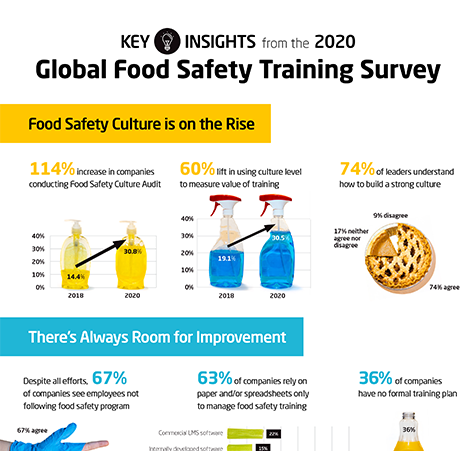
Intertek Alchemy released a new report analyzing the results from the 6th annual Global Food Safety Training Survey. Why is this big news? The survey contains valuable data on food safety training programs and identifies areas for improvement in food safety training — insight that can help all companies improve their own training programs.
Save Space for Training: Make this Afterthought of Plant Design a Focal Point
Posted by Kristin Kastrup
Many manufacturing and food processing facilities are housed in buildings constructed before the acceleration of technology; many were designed before the idea of WiFi even existed. As a result, many companies in this industry have some design challenges to deal with daily that may impact productivity and training. Challenges like low visibility on the production floor or lack of convenient training space can make training space feel like an afterthought.
Topics: Training Best Practices
Training Engagement Tips for Your Operations Leaders, Part 2: Commitment
Posted by Chance Navarrete, Sr. Product Manager
It can be challenging to get your operations leaders to commit to staying on track with an ongoing training course. In this part of our conversation, Kastrup and Rysavy expanded upon the second “C” of the four core elements — commitment — and shared the best approach for dividing up responsibilities and ownership in a healthy training process:
Training Engagement Tips for Your Operations Leaders, Part 1: Collaboration
Posted by Chance Navarrete, Sr. Product Manager
Operations leaders are constantly juggling a demanding number of production goals, from reaching daily quotas to maximizing the utilization of equipment. With all of their critical responsibilities, it’s easy to see how staying on track with an ongoing training plan can fall by the wayside!
Six Benefits of eLearning to Train Frontline Manufacturing Workers
Posted by Erin Silver EVP, Client Services
Many benefits of eLearning aren’t entirely new. But the inherent challenges of a manufacturing facility and workforce have made widespread eLearning programs harder to implement than in an office setting. But times are changing. Even in WiFi-scarce facilities, eLearning is being used more frequently, and mobile capabilities are being embraced where they were once impractical.
So how does eLearning specifically benefit frontline workers in manufacturing? Let’s take a look:
Topics: Training Best Practices
Are you a manufacturing company? If so, the likelihood that you are using a training platform designed for the average, college-educated office worker is pretty high. Almost every employee training program is built using the same techniques, methods, and philosophies of training developed for a corporate, sit-down-at-your-desk-and-work-on-your-computer type environment.
But for workers on the production floor, this is not only impractical, but dangerous. Those suit-and-tie DVDs (and even VHS tapes!) don’t resonate with production team members.
Topics: Training Best Practices